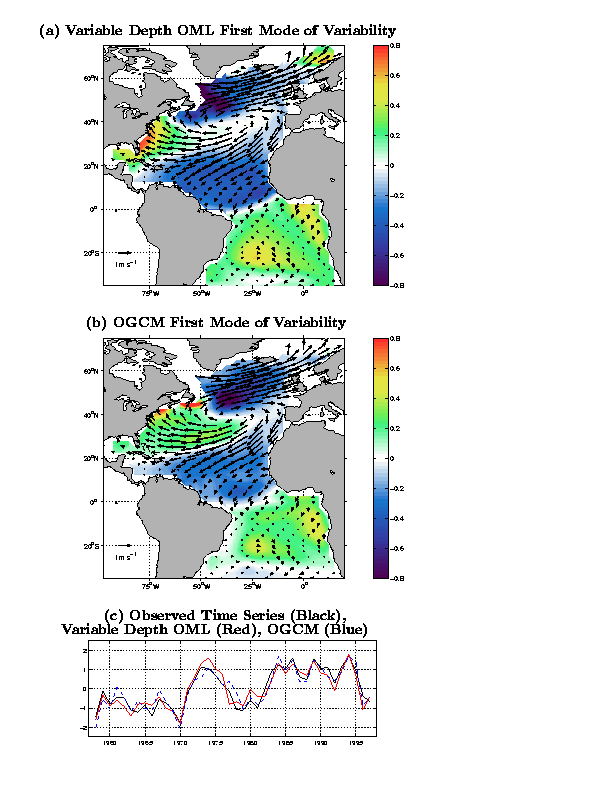
In this section we simulate the SST anomalies using a variable depth ocean mixed layer while still holding ocean heat transports fixed at their climatological values. The mixed layer depth was diagnosed from the computed values in the full GCM experiment described below. We then compute a climatological seasonal cycle of GCM mixed layer depths at each model grid point and impose these in the SST calculation. Therefore, as with the case of the uniform depth layer, the SSTs are still decoupled from the water below. The SST anomalies evolve according to the schematic equation:
![\begin{displaymath}\frac{\partial T'}{\partial t} =
\frac{1}{\rho c_pH(x,y,t)}\left[Q(T'+\bar{T}_{obs})-Q(\bar{T}_{obs})\right].
\end{displaymath}](img34.gif) |
(6) |
The spatial patterns of the first mode of variability during winter which explains 23% of the variance of SST, and its time series, as derived by an SVD analysis of modeled SSTs and observed winds are shown in Figures 7a and 7c. This mode is very similar to that derived with a uniform depth mixed layer but there are important differences. In the North Atlantic the amplitude of the modeled SST anomalies generally decreases. This is because the modeled mixed layer depth is much deeper than 75m so that the same flux anomalies generate smaller changes in SST. The deeper modeled mixed layer depths are more realistic but, while the SST anomalies simulated in the far North Atlantic with the uniform depth layer were too large, they are now too small using the variable depth layer. In the subtropical South Atlantic, use of the variable depth mixed layer increases the size of the SST anomalies because the mixed layers in this region, where it is local summer, are shallower than 75m. The modeled SST anomalies would, however, appear to be too large suggesting that maybe the real mixed layer depth is somewhere between 75m and that modeled by the mixed layer model. Variations in mixed layer depth have an important effect on the the SST variability.