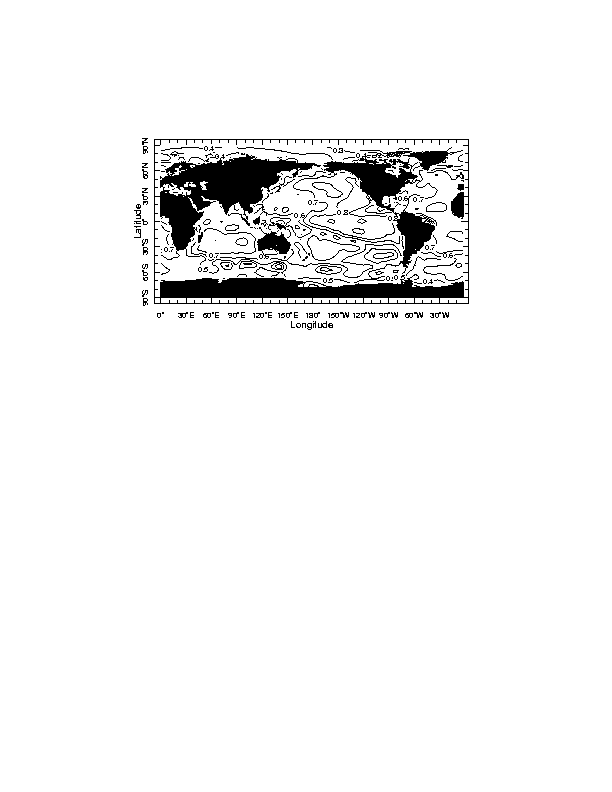
Before we examine the SST anomalies simulated using the AML model we will consider the results derived by forcing an ocean mixed layer model with surface fluxes evaluated using bulk formulae and observed air temperature and specific humidity. It is quite common to use observed air temperature and humidity in ocean model boundary conditions and a simulation of the Atlantic Ocean that uses this design has been presented by Battisti et al. (1995). We simulated the global SST anomalies from 1958 to 1998 forcing a 75m deep ocean mixed layer with surface fluxes computed with bulk formulas and the modeled SSTs and the NCEP observed air temperature and humidity. Figure 5 shows the global map of correlation coefficients between the time series of observed and modeled SST anomalies. The correlation is good to excellent almost everywhere. The amplitude of the modeled SST anomalies, as estimated by regression (not shown), are also reasonable. This might be taken to indicate that almost all the SST variability is flux-driven. However, we also see that the correlation is good in the tropical Pacific Ocean where we know that the SSTs are actually driven by changes in ocean heat transport.
This result is inevitable. The air-sea temperature difference is constrained to be whatever is needed to balance the radiative cooling of the subcloud layer (e.g. Betts and Ridgway 1989). The radiative flux divergence across the subcloud layer varies by very little and is typically about 10Wm-2. The sensible heat flux at cloud base is downward and typically small (e.g. Betts 1976). Since condensation and evaporation of falling rain are small terms in the subcloud layer, the SST and air temperatures must adjust to provide a surface sensible heat flux that balances the radiative flux divergence. Therefore the surface flux must also be about 10Wm-2 which requires an air-sea temperature difference on the order of 1K. Similarly the air-sea humidity difference always adjusts such that the surface relative humidity remains at about 80%, as the evaporation and entrainment of air at cloud base come into balance. The reasons for this are less clear than for the case of the air-sea temperature difference but this uniformity of surface relative humidity is nonetheless an undisputed fact of life for the marine boundary layer.
Consequently, the air temperature and air humidity are imprinted with the SST. Specifying them in the ocean model boundary conditions guarantees that the SST will approach its observed value and ensures that even ENSO related SST changes are simulated despite the ocean heat transport remaining fixed. Of course in this model the ENSO related SST changes are caused by changes in the surface fluxes and this is not so in the real world. Therefore, it may be possible to sort out the roles of surface fluxes and ocean heat transport in this experimental arrangement but only by simultaneously comparing modeled and observed SSTs and surface fluxes. This is what Battisti et al. (1995) attempted to do. Nonetheless, this remains a methodology that is prone to be ambiguous and misleading. Since the air temperature and humidity and SST equilibrate to each other in all circumstances this argument is valid in cases where the atmosphere is forcing the ocean as well as in cases where the ocean is forcing the atmosphere (e.g. ENSO). Clearly, when we are interested in simulating and understanding SST variability it makes sense to explicitly model the coupling of the atmospheric and oceanic boundary layers and to avoid specification of the atmospheric thermodynamic state.