In this study we first examined how surface heat fluxes have varied over the Atlantic Ocean during the last four decades. We analyzed the different terms in the lowest level thermodynamic energy budget using NCEP reanalyzed data. In agreement with the results of others (e.g. Cayan 1992a, 1992b) we have shown that changes in wind speed dominate the changes in surface fluxes over the subtropical North Atlantic but that further north anomalous advection is also important, especially advection of cold and dry air off North America. Changes in wind speed and direction cause changes in surface fluxes that force SST changes. We also found that anomalous subsidence can create changes in surface fluxes that damp SST anomalies. Changes in atmospheric eddy fluxes also primarily damp SST anomalies. Therefore, as far as the SST is concerned, it is changes in the mean atmospheric flow that create the SST anomalies while the eddies damp them.
Next we were able to show that a simple model of the atmospheric mixed layer (AML) that balances surface fluxes, radiation, subsidence, advection and eddy transports, was quite capable of reproducing the observed surface flux variability when forced by observed SSTs. This suggests that it would be possible to simulate the SST variability with an ocean model coupled to the AML model. We used three different ocean models: two in which the ocean heat transports were held fixed at their seasonally varying climatological values, the first with a uniform 75m depth and the second with a mixed layer model that allows the depth to vary and, third, a full ocean GCM in which ocean heat transports varied.
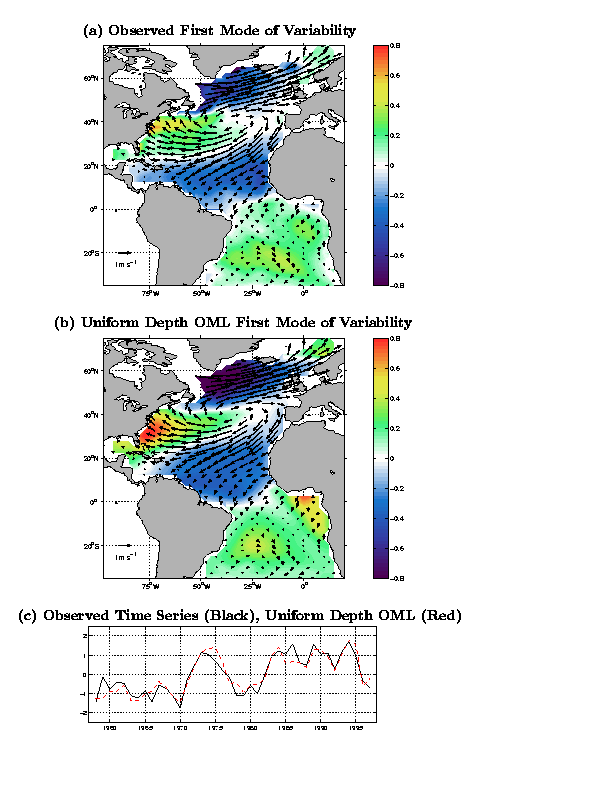
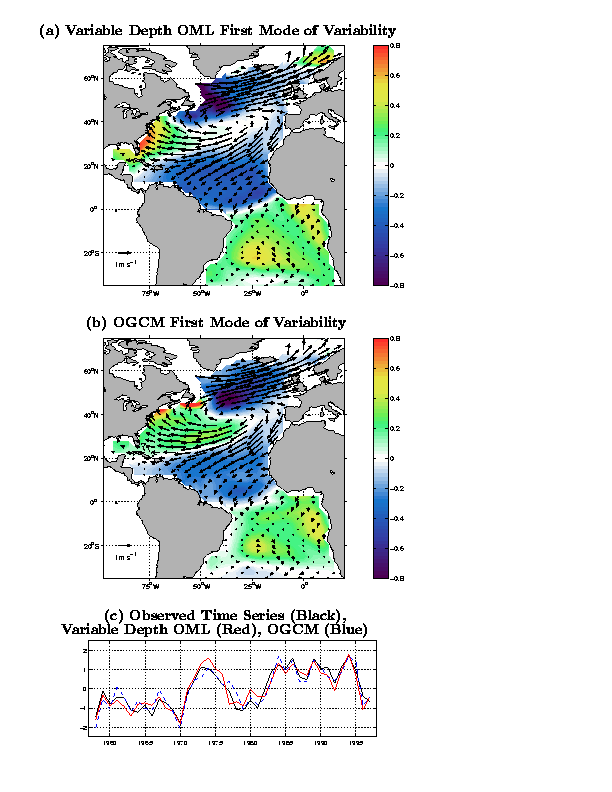
The SST variations simulated by the uniform depth mixed layer model were surprisingly similar to those observed. The model reproduces the familiar tripole banded structure of SST anomalies associated with the NAO and also reproduces the long term trend in that pattern associated with the trend towards the high index state of the NAO (Hurrell 1995). This result makes it clear that to first order the variations of Atlantic Ocean SSTs since 1958 can be explained as the response to variations in atmospheric circulation. This is true at all time scales. By comparing this result with the SSTs simulated using a variable depth ocean mixed layer we were able to assess the role of mixing. The deep winter mixed layers of the far North Atlantic greatly restricted the amplitude of SST anomalies forced by surface fluxes and, in fact, they were too small. In the South Atlantic the shallow summer mixed layers increase the SST anomalies.
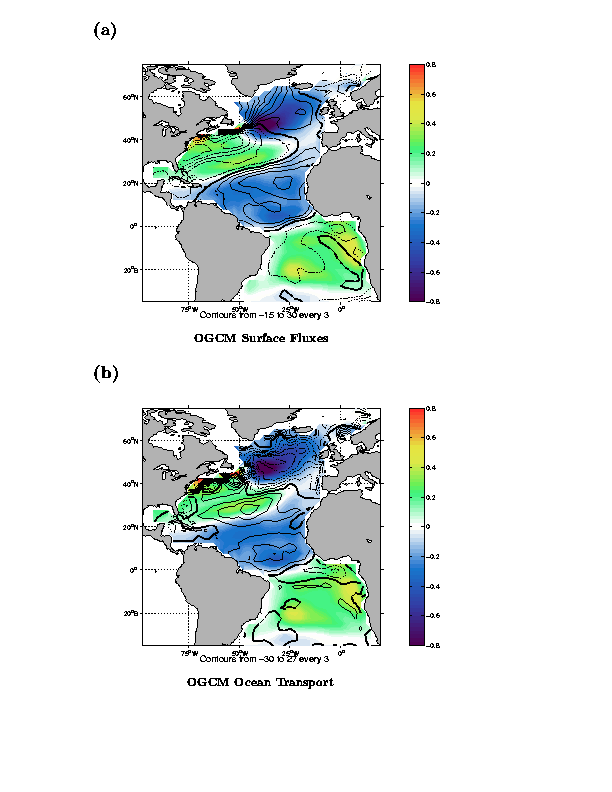
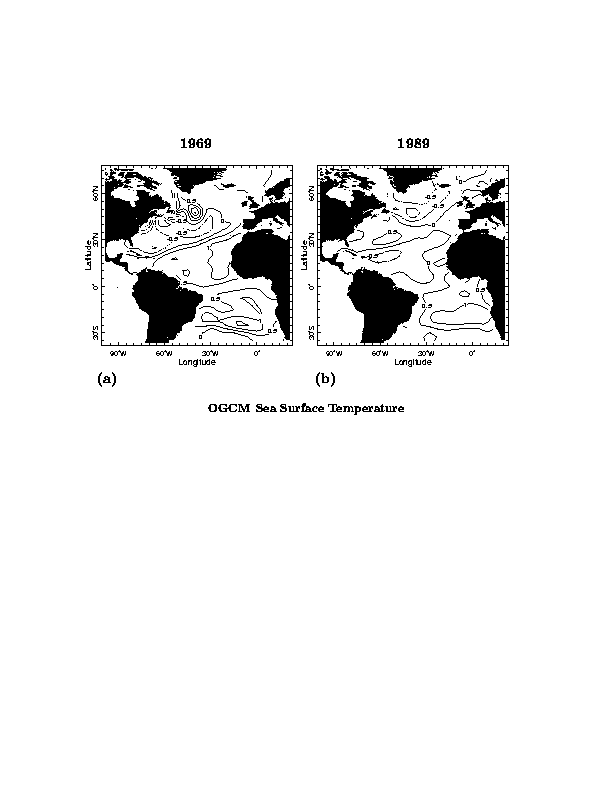
The full ocean GCM also includes the variable depth ocean mixed layer model but also allows the ocean heat transport to vary. Changes in ocean heat transport are important in the far North Atlantic. Here, when anomalous westerlies cool the SSTs by surface fluxes, they also create an anomalous equatorward Ekman drift that enhances the cooling. The SST anomalies in this simulation were realistic suggesting that here surface fluxes, mixing and changes in ocean heat transport are all important. In the subtropics when anomalous easterlies cool the SST they drive a poleward Ekman drift that warms the water but this effect seems to be small and of questionable significance. Further north, anomalous poleward Ekman drift warms the area to the south of the North Atlantic Drift and greatly improves the realism of the SST simulation relative to the mixed layer models. We were only able to identify a role for anomalous Ekman drifts. These are generated almost instantaneously and cannot provide any long term memory that could lead to oscillatory behavior (e.g. decadal variability). Analyses of the heat budgets in various regions did not uncover any evidence that ocean heat transports systematically lead or lag the SSTs. Instead, where there was a clear signal in changes in ocean heat transport, (e.g. the far North Atlantic) it was in phase with the SST changes forced by surface fluxes.
The results of an ocean modeling study alone cannot be used to fully explain climate variability in the Atlantic sector. While we have demonstrated that changes in the surface fluxes forced by a changed atmospheric circulation and, to a much lesser extent, changes in ocean heat transport, can be successfully invoked to explain the variations of Atlantic SST we cannot explain why the atmospheric circulation changed in the first place. The current results are consistent with the atmosphere forcing the ocean at all timescales, including decadal, but this raises a particularly difficult question: where does the persistence from one winter to another, including the long term trends, come from? Atmospheric timescales appear to be too short to explain such low frequency behavior while they may easily explain persistence during a winter. There are several possible explanations for the low frequency behavior which we consider in turn.
This conclusion is in contrast with the recent claims of Rodwell et al. (1999). They forced an atmospheric GCM with observed SSTs and reproduced much of the observed behavior of the NAO since 1947. They suggest this means that the NAO's behavior was forced by the ocean. However, we note that their surface fluxes vary with SSTs in the opposite way to that observed. That is, they damp the SST anomalies rather than force the SST anomalies as observed. It is puzzling how their model can reproduce the observed trends in circulation while at the same time the air-sea heat fluxes have the opposite trend to that observed.
Our ocean modeling experiments indicate that over the last four decades Atlantic Ocean climate variability can be adequately explained in terms of the ocean being forced by changes in atmospheric circulation. Progress therefore requires understanding why the atmospheric circulation changed. We need to discover what can excite trends in the circulation and what can cause persistence from one winter to another. Changes in the distribution of atmospheric convection in the tropical Atlantic sector are one possibility, greenhouse warming is another and there are probably others. In terms of the persistence within a winter our observational analysis of the thermodynamic budget of the lower part of the atmosphere is revealing. Clearly the mean flow creates SST anomalies that the atmospheric eddies damp. This may not be a fortuitous arrangement. It is possible that the atmospheric eddies force changes in the mean flow via changes in eddy momentum fluxes. These changes in the mean flow create surface flux and SST changes that the eddy heat fluxes then try to damp. This three way coupling between the eddies, the mean flow and the SST may arrange itself in such a way as to allow persistence and will generally redden the spectrum of variability. This will be the topic of future work.
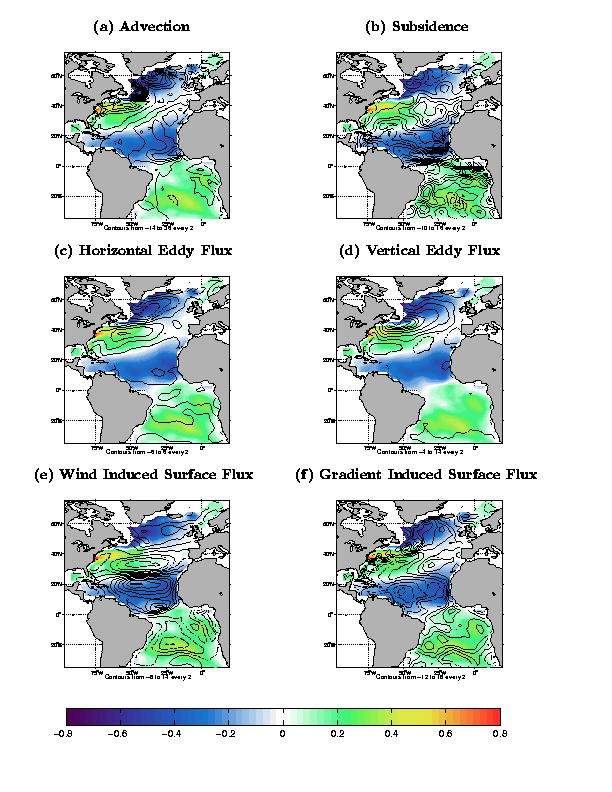
The relationship of various terms in the moist static energy budget of the lowest level of the atmosphere to the underlying SST variability. The first EOF of NCEP observed SST is shown in color. Values represent one standard deviation of the corresponding time series. The regressions of the energy budget terms onto the time series of the EOF of SST are contoured. Shown are anomalies of (a) advection, (b) subsidence, (c) the horizontal eddy flux convergence, (d) the vertical eddy flux convergence, (e) the surface flux given by anomalous winds working on the mean vertical gradient of moist static energy and (f) the surface flux given by the mean wind working on the anomalous vertical gradient of moist static energy. The energy budget terms are in Wm-2.
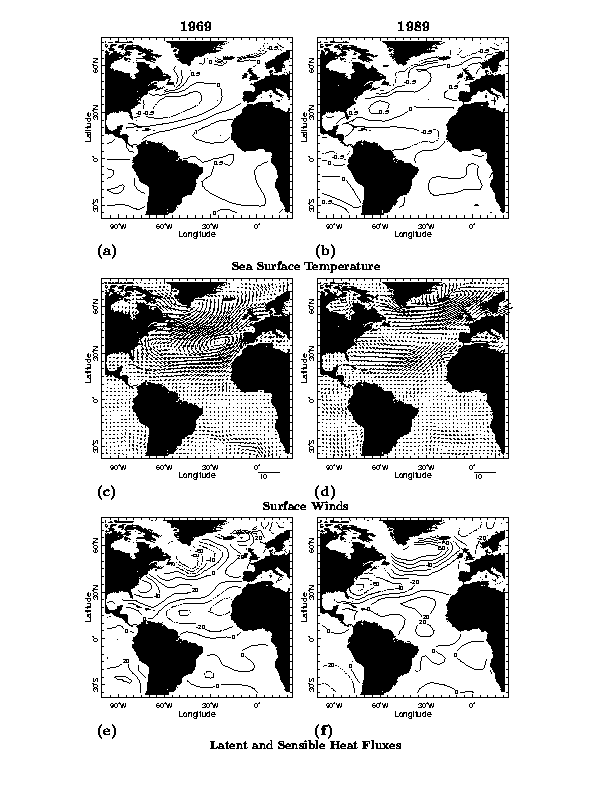
NCEP reanalyzed anomalies for January-February-March seasonal means of 1969 and 1989 of (a) and (b) SST, (c) and (d) surface wind and (e) and (f) the latent plus sensible heat flux.
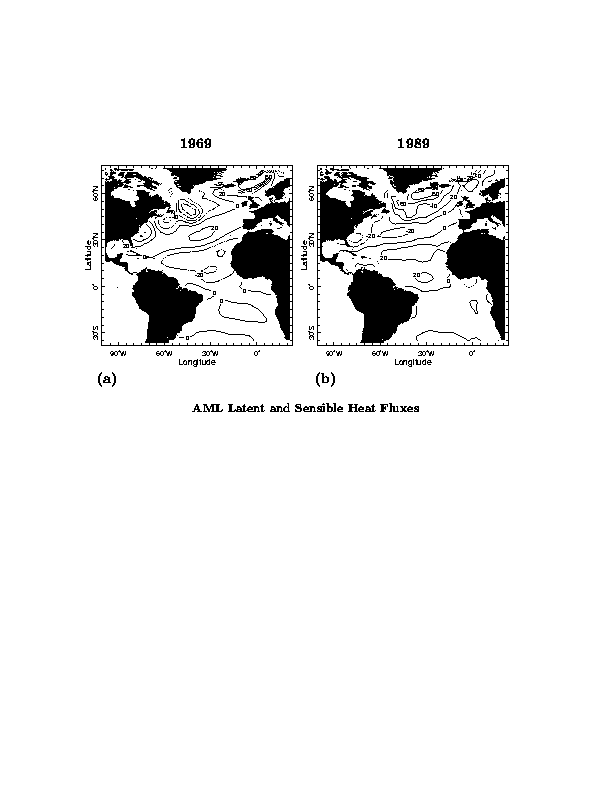
The latent plus sensible heat flux anomalies in Wm-2 simulated by the AML model when forced by NCEP reanalyzed SSTs and winds for January-February-March seasonal means for (a) 1969 and (b) 1989.
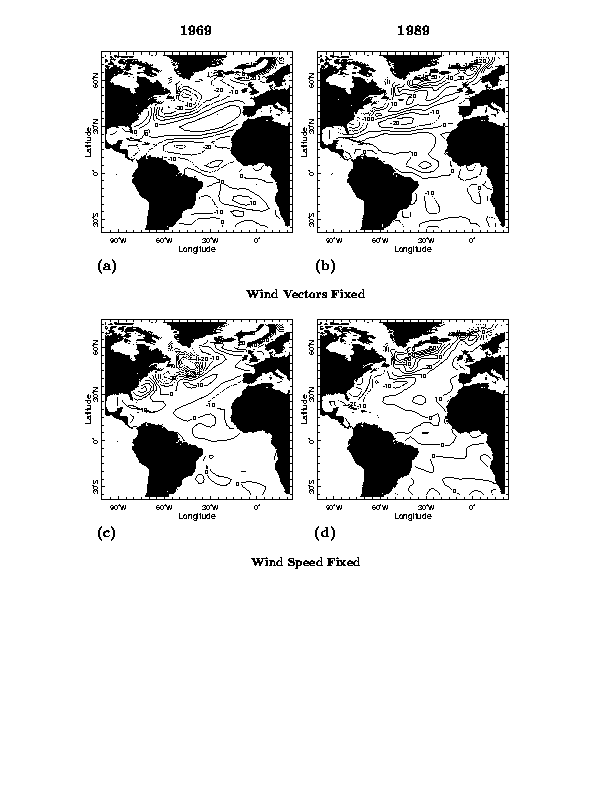
Same as for Figure 2 but for the cases where (a) the wind vectors are held fixed and only wind speed varies and (b) the wind vectors change but the wind speed is held fixed.
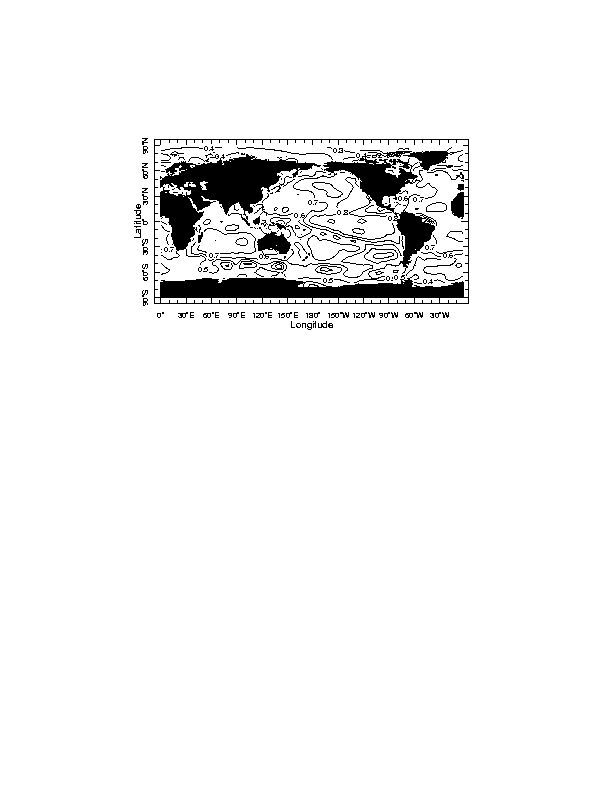
The correlation coefficient between observed and modeled SST anomalies as computed with a 75m deep ocean mixed layer forced b surface flux anomalies only computed using standard bulk formula and observed surface air temperature and humidity. Ocean heat transports do not vary except for an imposed seasonal cycle. The correlation is good to excellent everywhere, even in the tropical Pacific, indicating that using the observed thermodynamic properties of the atmospheric boundary layer ensures a good SST simulation but frequently for the wrong reason.
(a) Results of an SVD analysis between NCEP wind vectors and SST anomalies during the January to March season. This first mode explains 23% of the variance in SST and 25% and 20% of the monthly zonal and meridional winds respectively and is associated with the North Atlantic Oscillation. In (b) we show the same analysis performed with the SST anomalies computed by a 75m deep ocean mixed layer coupled to the atmospheric mixed layer model. The patterns in (b) explain 23%, 27% and 29% of the seasonal mean SST, zonal and meridional wind anomalies, respectively. The time series of the observed and modeled SST modes are also shown.
Same as for Figure 6 but for the cases where the SST anomalies were computed with a variable depth ocean mixed layer and (b) with the full dynamical ocean GCM both coupled to the AML model.
The regression of the anomalies of the modeled surface heat flux (positive if it cools the ocean) and ocean heat transport (positive if it warms the ocean) onto the time series of the first mode of SST variability shown in Figure 7b. The surface and dynamical heat fluxes are contoured in Wm-2 and represent the variations associated with a one standard deviation fluctuation in the principal component.
The SST anomalies for January-February-March seasonal means as simulated by the ocean GCM for (a) 1969 and (b) 1989. These can be compared to the corresponding figures for the observed anomalies in Figure 3.